About us
Why Snellius?
Where our name comes from, and what a 17th-century mathematician from Leiden has to do with robots.
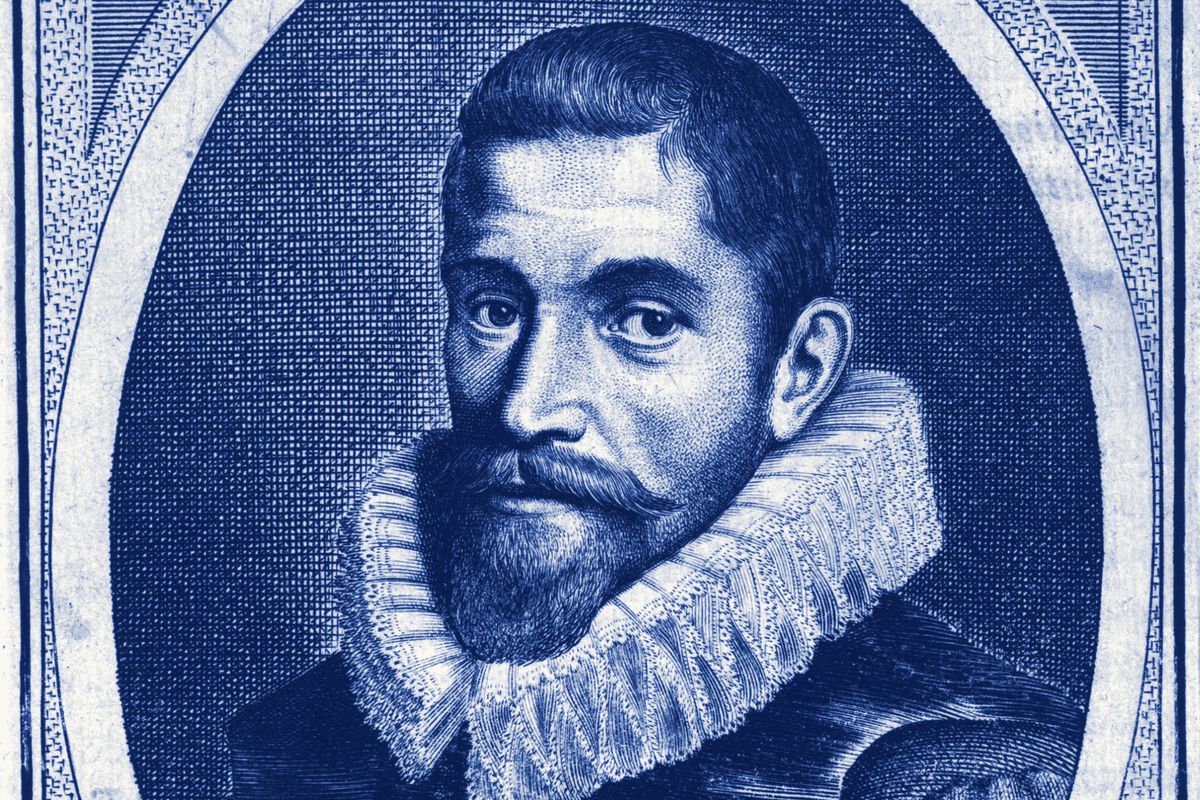
Who was Snellius?
Perhaps the name Snellius rings a bell. It may well: Willebrord Snel van Royen (known by his Latin name Snellius) was a physicist and mathematician from Leiden in the early 17th century. He worked on all kinds of geometric and mathematical problems of his time. We highlight two of his most important achievements here: Snell's law and his successful attempt to measure the circumference of the Earth.
The circumference of the Earth
Snellius learned from his Greek teachers of antiquity, in particular Eratosthenes, who had already attempted to measure the circumference of the Earth in Alexandria. Snellius wanted to do it better, and he succeeded. He used the same method, which required him to measure distances and angles. He had his own quadrant built to measure angles with great precision, and climbed countless houses and church towers to take these measurements. This allowed him, in 1617, to measure the circumference of the Earth with an error of just 3.5%!
Snell's law
Snell's law is the law of nature that describes how light behaves when it passes into a different medium, for example from air into glass. Mathematically, it reads:
n1 sin θ1 = n2 sin θ2
The finding that light behaves this way, depending on the angle of incidence and the refractive indices n1 and n2, is widely applicable and fundamental to geometric optics. It describes how fibre-optic cables work, how light behaves in water, and much more. Snellius was probably not the first to describe it, by the way (the Arab mathematician Ibn Sahl did so as early as the 10th century), but he did bring this knowledge back into modern science.
Snellius' work symbolises what we do: measuring accurately with cutting-edge equipment, collecting data, and using it to get real work done in the real world.
Take another look at our logo: a ray of light bending at a line. That is Snell's law. For us it is a reminder: if you want to understand the world, you first have to measure it well.
Curious about what we do?
Feel free to call or email us, we're happy to tell you more.